What Makes Your Bedroom Look Smaller Than It Is

A cramped bedroom is rarely a square-footage problem. Most of what shrinks a small room is fixable without knocking down a wall or moving house.
The usual suspects are predictable: too much furniture, the wrong rug, heavy curtains, and surfaces buried under things you stopped noticing. Here is what to change and how.
1. Too Much Furniture
Overfilling a bedroom with pieces is one of the most common mistakes that shrinks it. Every spare chair, bench, or accent table fights for floor space and makes the room read as crowded.
In a small bedroom, a bed, two nightstands, and a dresser usually cover it. If a corner chair is only collecting discarded clothes, it is not furniture, it is storage you do not want.
Instead: fewer pieces, better scaled.
Scaling down rather than sizing up works better in a tight room. A handful of pieces sized properly to the room makes it feel larger every time.
Styling tip
Before you buy anything, ask whether each existing piece is actually used. If a chair only holds laundry, remove it and watch the floor open up.
2. A Bed That's Too Big
The bed is the largest object in the room and should earn its footprint. When it crowds out circulation, the whole space feels tight.
A good test: with the bed against a wall, you should still be able to pass freely along its other three sides. A bed that only leaves a sliver of walking room around it is too big.
Match the bed to the room, not the other way around, and reclaim the floor space you need to move comfortably around it.
3. A Rug That's Too Small
An undersized rug shrinks a bedroom faster than almost anything. A rug that extends only slightly past the bed leaves the whole room feeling disconnected and visually smaller.
Go larger. Buy a rug big enough for all the furniture to sit on top of it, so you step onto the rug the moment your feet hit the floor in the morning.
Instead: anchor the floor, frame the room.
Leave about a foot of flooring showing around the perimeter. That border frames the space and pulls the room together, so it reads as larger. Too much exposed floor fragments the room visually and makes it feel more confined.
4. Heavy Curtains Blocking Light
Bulky curtains and shades eat into the visual space of a room and make it feel cramped and darker. Blocking natural light is one of the fastest ways to shrink a room.
Daylight is among the strongest tools you have for opening up a room. Choose light, airy curtains or blinds you can draw fully back, and open them as soon as you wake.
DIY tip
Swap heavy drapes for light, airy curtains or blinds that pull all the way back from the glass. Open them the moment you wake so daylight can carry across the room.
5. Furniture Blocking the Windows
Parking furniture in front of windows does a lot to make a room feel smaller. It blocks both the light and the sightline out, two things a small room depends on.
Move furniture away from the windows. Clearing them lets daylight carry across the room, and the depth from the play of light and shadow makes the space feel larger and more welcoming.
6. Everything Pushed Against the Walls
Shoving furniture to the edges seems like it creates space, but lining the walls can flatten a bedroom and leave you with narrow paths to move through. It does not always produce the most open result.
Floating the bed, pulling it away from the wall, can improve flow and create a more interesting layout. Centering the bed in the room often produces a more open, functional floor plan than hugging a wall ever does.
7. Cluttered Surfaces
Nightstands, dressers, and walls that are too busy generate visual noise. Clutter on surfaces suffocates a small room, and clear surfaces are vital for a calm environment.
More often than not, the room's size is not the real problem. It is the habits and the stuff that builds up inside it.
Candles, ornaments, book stacks, and toiletries are the first to go: if it does not get used daily, it does not belong on the surface.
Instead: edit down to a few meaningful pieces.
Limit decorative objects to a few meaningful pieces and keep tabletops uncluttered. Edit displays regularly, keep a few favourites out, and clear the rest by storing or donating it.
Budget tip
Trays and baskets corral what stays out for next to nothing. Group small items on one tray instead of scattering them across every surface.
8. Laundry Taking Over
A narrow hamper that slides into the wardrobe or tucks behind a door keeps the laundry out of sight and off the furniture.
A chair stacked with worn-once jumpers reads as instant clutter, so be honest with yourself about what belongs in the wardrobe. The goal is a surface that stays clear enough to feel restful.
9. Chunky Bedside Tables
Bulky bedside tables overwhelm a small room, eating floor space the bed already claims most of.
Trade them for a slimmer design or a shelf fixed to the wall. Going vertical frees the floor and keeps the essentials within reach.
A well-planned bedside table with generous storage can also cut the need for extra baskets and organisers.
10. Single-Use Furniture
Single-use pieces miss the chance to save space. In a tight room, furniture that does one job is a luxury you cannot afford.
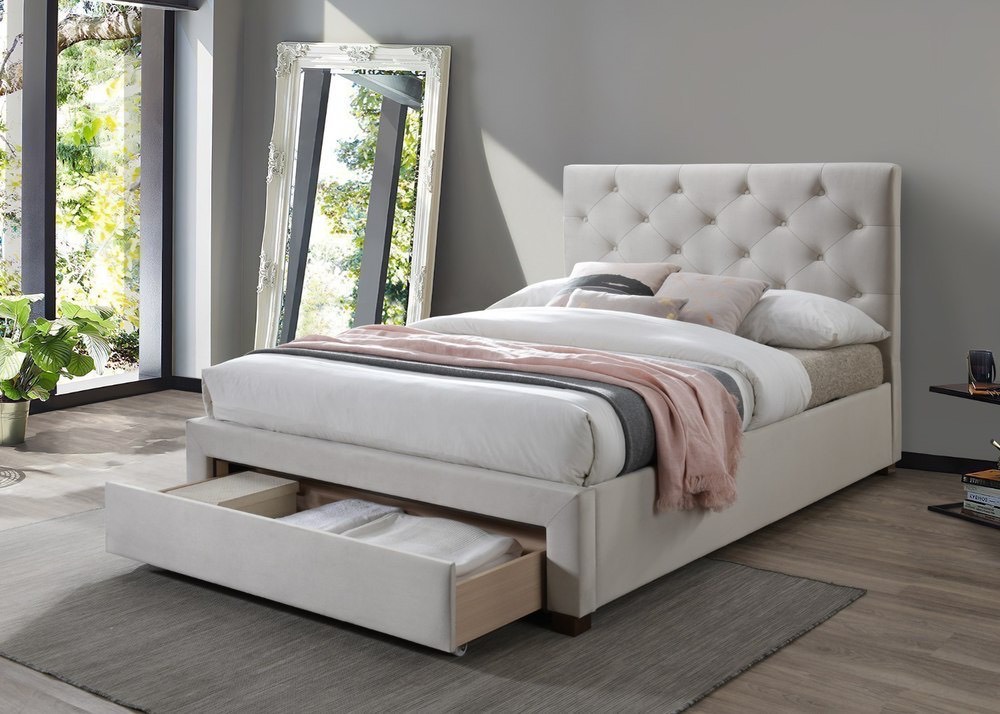
Choose multifunctional designs with built-in storage. A storage bed with drawers underneath provides concealed storage, cuts visual clutter, and helps the room feel lighter. A desk that doubles as a vanity does the same work.
Instead: give the headboard a job.
Since beds take up a large footprint, surrounding furniture has to work hard. The right headboard draws the eye upward and gives a small room the focal point it is missing, so the whole space feels more deliberate.
A statement headboard supplies that anchor.
11. Exercise Equipment
Weights, yoga mats, and treadmills are common space-stealers that turn a bedroom into a general storage zone.
Ideally, this gear gets its own dedicated storage area elsewhere. If it has to live in the room, keep it tucked out of the main sightline rather than claiming the floor.
Final Thoughts
Most of what makes a bedroom feel small is removable. The illusion of more space usually comes from what you take away, not what you add.
Start with the bed and rug, since they set the scale of everything else, then clear the windows and surfaces. Keep the pieces that earn their footprint, and your room will read larger without losing a single square foot.